





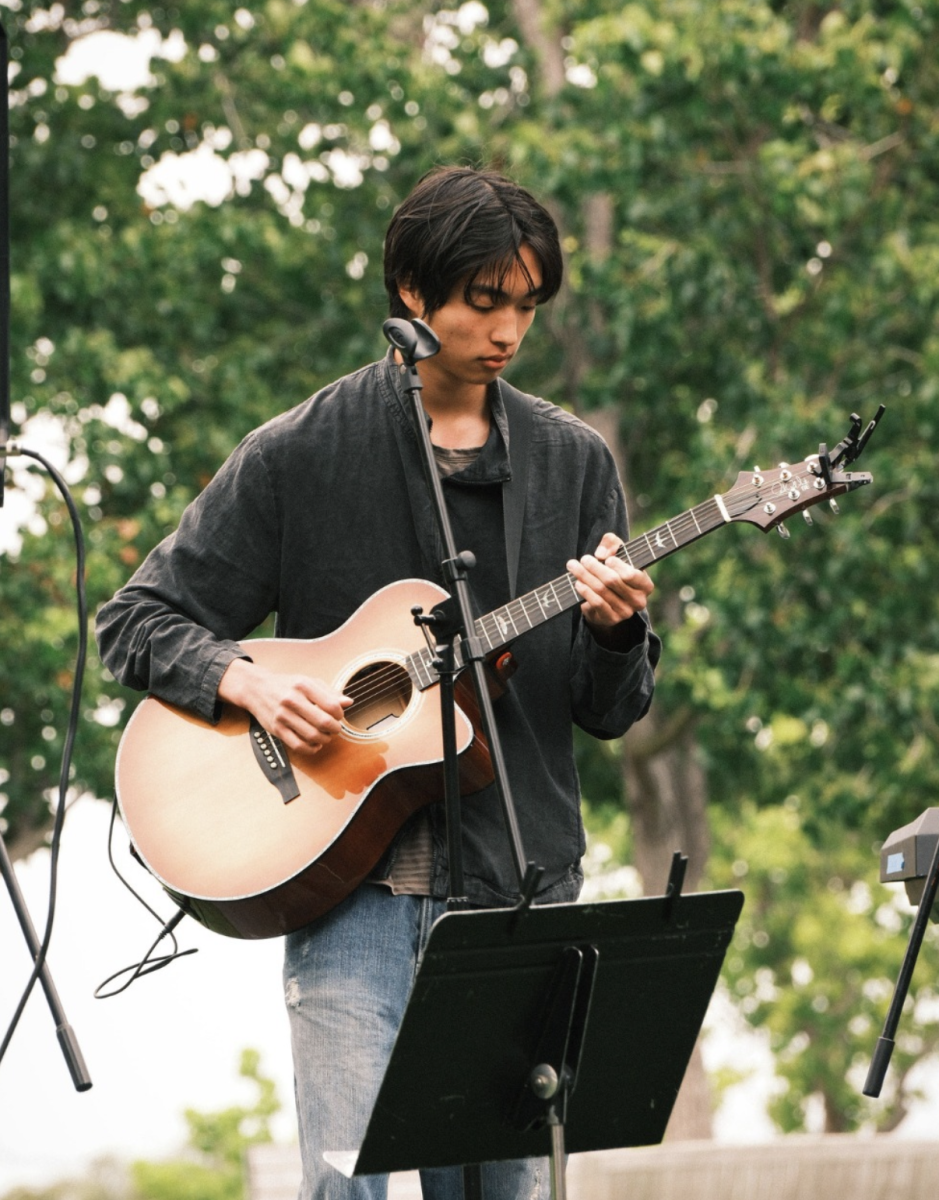







After folk-pop singer-songwriter Noah Kahan went viral in 2022 with his single Stick Season, soon followed by his eponymous chart-topping album, I wondered if another TikTok musician would become a one-hit wonder. Kahan’s mainstream commercial breakthrough created high anticipation for his next studio album, The Great Divide.
Released on April 30, the 17-song album debuted at #1 in the United States, broke sales records, and garnered positive critical acclaim. The project is commendable for its raw, confessional songwriting paired with Kahan’s soulful Northern New England dialect. However, its length and musical repetitiveness burden the listener with muddled sounds throughout, making the album best for what I call a “long vibe listen.”
Much of Kahan’s music is centered around personal growth, mental health struggles, and growing up in his small town of Strafford, Vermont. The Great Divide chronicles his rising popularity and personal changes through discussing attitudes towards newfound fame, attachment to hometown, and Kahan’s signature self-confessions.
The instrumentals continue Stick Season’s folk feel but are angstier thanks to new collaborator Aaron Dessner’s production. Simpler arrangements are replaced with a vocal and electric guitar focus over several instrumental build-ups.
The opener “End of August” previews the album’s overall atmosphere: delicate piano chords contrast hollow bass notes, and Kahan switches between deep, soulful tones and airy falsettos. Instruments layer upon each other, peaking at a cymbal crash before fading into soft piano notes. The strong reverb creates a nostalgic, tender atmosphere that accompanies the journey of rise, expansion, and fall that the song and album both convey.
Kahan continues his style of incorporating personal references into his songwriting, and frequently utilizes the second person (“you”) to invite the listener into a familiar experience. In “End of August,” he sings, “05072”, his hometown ZIP code, alluding to fond memories. “Doors” discusses Kahan’s personal struggles with “That I’m the trouble ahead, that I scream in my sleep / You’re puttin’ money on red, I’m a sure bet at a losin’ streak.”
The next few songs explore Kahan’s appreciation for Strafford and mixed feelings on leaving. “Downfall” stands out for its gentle tones paired with resentful lyrics: “Call me when the bugs don’t die and the spring looks just like autumn / Oh, tell me when you miss the climb from a hole that has no bottom / I’m hoping that the view ain’t nice, that the streetlights bleed into your bedroom.”
While lyrically strong, the instrumentation feels unsuited at times, especially in “American Cars” and “Paid Time Off.” The layering of electric guitars and strings brings a full sound but makes the choruses feel overpolished and crowded. Yearning, thumping verse rhythms anticipate a raw, emotional climax, instead of the poppy, detached mismatch.
“The Great Divide” effectively follows up, however, with interesting musical flux, harp-like riffs, and emotional singing that prove itself as the titular song. Kahan acknowledges his previous misjudgments, singing, “You know I think about you all the time / And my deep misunderstanding of your life.” He goes on to wish the other person, “I hope you’re scared of only ordinary [things] / … / And not your soul and what He might do with it.”
The “Great Divide” symbolizes Kahan’s main takeaway as a separation of paths, and making peace with others’ ways of life—instead of worrying about how they should be living (as deemed by God, or “He”). This reconciliation continues in “Haircut” as he sings about bitterness from old acquaintances due to his fame. Interestingly, “Haircut” suddenly departs from the intricate, moody electric guitars and resembles the bright acoustic guitar sound of his earlier work.
The shift makes the middle of the album feel out of place musically. No matter how much I listen to them, I cannot distinguish the next few songs from one another. Kahan continuously grieves about a toxic attachment to a presumed lover, with the same desperate singing and trembling vibrato.
“Porch Light” and “Deny Deny Deny” are rare gems where the music works, though. The repetition of the pre-chorus in the former effectively creates urgent, captivating rhythms. In the latter, the guitars start heavy and loud, a refreshing deviation.
By this three-quarters mark, The Great Divide begins to feel drawn-out, especially with the jump scare that is “Headed North,” whose campfire-feel spoken passages and excessive profanity add little to the album’s narrative.
Kahan becomes more introspective towards the end of the project, reflecting on shameful actions and faults. “Spoiled,” for example, highlights his guilt and expectation that his future children will blame him for their problems: “Just so my children get spoiled when they get old / So they can [screw] up all they want and blame it all on their dad.”
The closer, “Dan,” sums up the entire album by reminiscing about Strafford, with lyrics like “Where do we go when we die? / I wouldn’t mind right here, I wouldn’t mind at all” that express appreciation for even its imperfections. The Great Divide is thus a personal confession of grievances, love, and realization of Kahan’s attachment to his core experiences.
However, even with instrumental variances in “Deny Deny Deny” and “Headed North,” The Great Divide still repeats the same musical narratives to the point that it becomes a tiring listen. Lyrically, the album is strong, yet the similar instrumentals end up washing out the strength of Kahan’s words, while the themes become repetitive. Kahan himself sings in “All Them Horses,” “Gonna dance around and sing about my pain / Okay, it pays.”
If you ever need to listen to something that feels long and has a consistent angsty vibe throughout, pick The Great Divide (hence, I have dubbed it a “long vibe listen”).