










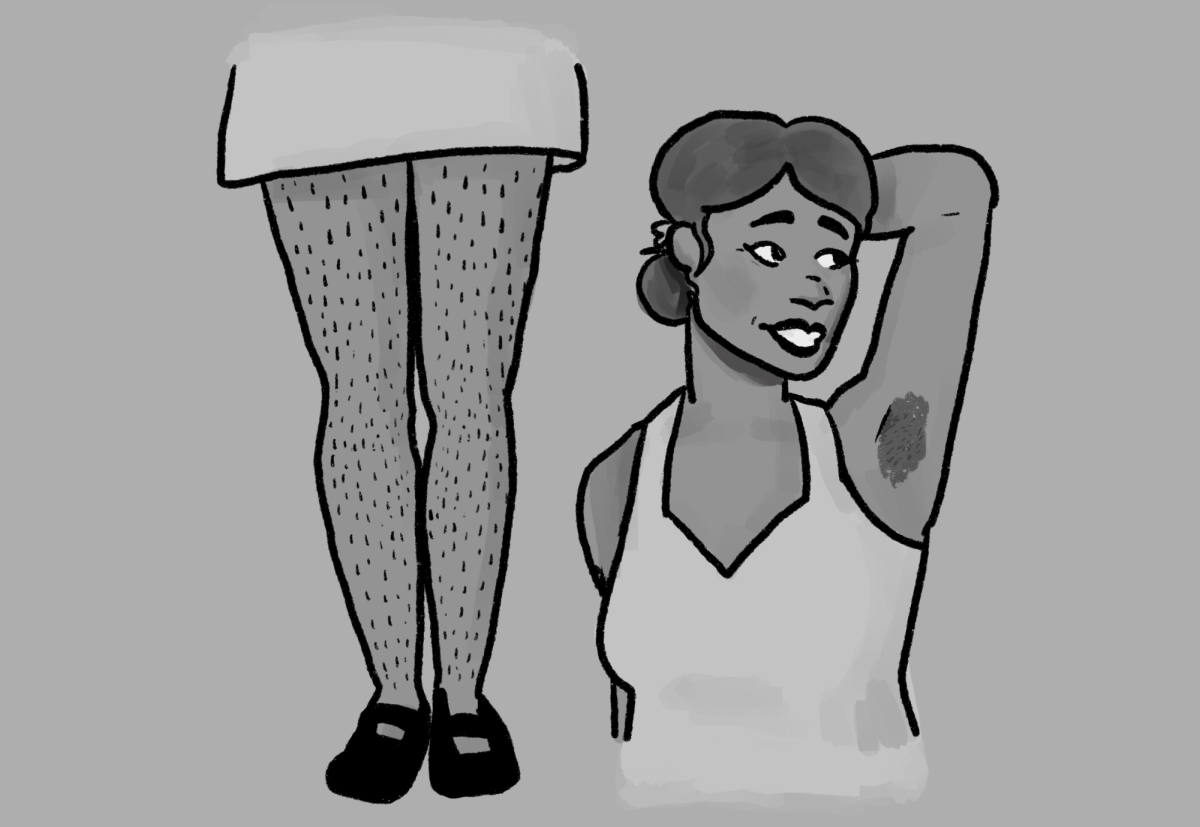
When I was younger, my mom would always assure me that after I graduate high school and turn 18, she would book me a laser hair removal appointment. She had made it sound like it was a prerequisite to adulthood, an important step to prove that I was a woman. From a young age, I understood that shaving was necessary for all women.
But, as I grew older, shaving was a routine that I often tried to avoid. I did not like the sharp razors cutting the hair that naturally grew around my body. I found it tedious, time-consuming, and unreasonable. But simultaneously, leaving the house in a tank top that displayed my armpit hair felt like a crime. Why did I feel this way?
The idealization of the hairless body is actually a result of years of historical and cultural practices.
In 1915, after Gillette created the first women’s razor, the company marketed the “Modern Woman” — a woman who was feminine, smooth, and hygienic because she shaves her body hair. Any woman who didn’t shave was left behind to stay in old times. According to Vox, in 1964 (just 49 years after they introduced the women’s razor), 98% of American women between ages 15 and 44 were removing their body hair.
Shaving a woman’s body hair is inherently transforming their body to a body that existed pre-puberty. In other words, we have been taught to believe that the body we were in as children is the ideal body. Why is it that our innocent and more “pure” bodies are the bodies that are attractive and entitled to validation?
A woman’s beauty should not be equated to a child’s innocence. The infantilization of women’s bodies has sustained the popularity of the hairless body.
Knowing what I know about the history and negative cultural connotations that come with being hairless, I still choose to shave once a week in order to maintain a hairless body. Why is that so? And does that make me less of a feminist?
My decision to shave is an example of choice feminism at work. Choice feminism is the idea that a woman’s decision to partake in any practices is all in her prerogative. Choice feminism allows women to feel empowered by their personal choices. That freedom to choose helps women feel connected to a larger collective.
Although choice feminism sounds nice on paper, in real life, it has its pitfalls. Choice feminism is only present to a privileged group of women; choice feminism assumes that every woman has agency to make her own choices and decisions. Oftentimes, systematic structures may prevent marginalized women from having the freedom to choose.
Another relevant reason as to why choice feminism fails to address women’s liberation is because most of the choices we make as women are influenced by social structures that have normalized the patriarchal mindset. In the situation for hairlessness, most women actively choose to shave because most women actively view themselves through the male gaze.
In my honest opinion, choice feminism is a form of personal indulgence; it ultimately reinforces the very norms women are trying to break.
It’s important to make the personal political. Deconstructing patriarchal norms that have been ingrained in our head is a choice that we can make. Being a feminist goes beyond choosing what feels good; it requires choosing what actively challenges the ideas holding us back.
And of course we cannot singlehandedly change the histories and cultural responses that have shaped a woman’s standard of beauty just by choosing to shave or not shave our body hair. Nonetheless, our choices hold a power that can liberate us from those same histories and cultural responses that have prevented us from being ourselves.