







English Department Courses
2026-2027
The English Department is excited to offer the following courses for the 2026-2027 year. Please assume all courses are Advanced Placement level unless otherwise specified, as we were encouraged to provide more pathways to a higher GPA. There are no prerequisites; you do not need to have even a passing interest in reading or writing to take an Advanced Placement English course.
The Semicolon: A History
Curious grammatics (that’s a grammar fanatic) will be delighted to study the history and evolution of the semicolon; its first purported use in print was in Italy in 1496. This course will analyze the way in which the semicolon provides a more profound separation between clauses than a comma; we’ll pay close attention to how it achieves a special kind of rhythm that eludes all other forms of punctuation. We will study major appearances of the semicolon from the Renaissance to the late 20th century; curious students may pursue a pattern of evidence that extends into the 21st century. All papers will be written in TEA; that is to say, “take every avenue” towards the semicolon.
The Thomases: A Collection
We will endeavor to study all major works by writers with the first or last name Thomas, including but not limited to Thomas Hardy, St. Thomas Aquinas, Thomas Payne, Dylan Thomas, Thomas Pynchon, and Tom Clancy. The goal of the class is to identify themes that connect these disparate Thomases, though who is to say there are uniting factors? You begin with an A+ if your name is Thomas.
1894: A Study of America
This course will examine every single American poem, essay, novella, novel, and nonfiction piece published in the critically important year of 1894. We will first examine the context of these acclaimed works; in America in 1894, Milton Hershey founded his eponymous chocolate company, Coca-Cola was first bottled, and the Great Hinkley Fire killed over 450 people in Minnesota. These seminal events inform why there was much better stuff written and published in Europe. Course assessments include a literary contextualization timeline in which students must identify the phase of the moon on the eve of each piece’s publication.
Honors American Literature: Into The American Mall
This course will examine the rise, proliferation, and decline of the indoor American Mall. We will map the evolution of the mall’s history and its many occupants to understand how and why mall architecture, dining, and fashion trends changed over the decades. Special topics include the history of the kiosk, the functional purpose of Cinnabon, Wet Seal vs. Contempo Casuals, and the power of Abercrombie and Fitch in the late 90s. This course includes four required overnight camping excursions to malls across Southern California.
Characters Who Die In Bodies of Water
This course will cover in depth the works of literature whose protagonists die in bodies of water. From ponds to lakes to gulfs to the sea, we will look at how these writers lead their characters to their watery grave. Our texts in this course will include Hamlet, Moby-Dick, Maggie: A Girl of the Streets, The Mill on the Floss, The Return of the Native, Rebecca, The Awakening, The Hours, The Covenant of Water, and more. Given the prolific reading list, as well as the fact that most of these books are at least 400 pages long, students will be required to complete about 1,000 pages of reading in advance, which means that at the current pace that most AP English courses can assign homework, students who want to take this course should start their reading in 9th grade in order to be prepared by senior year.
Transfer: The English Version
This course will provide students with a lengthy list of literary terms, themes, and tropes—T isn’t just for transfer!—and ask that you utilize and apply your knowledge to a new setting. Thus, course assessments will be an entirely fun surprise that you can’t really prepare for. We might ask you to write an epistolary exchange about misogyny that uses anadiplosis, anaphora, alliteration, and assonance. You may be tasked with crafting a Petrarchan sonnet about the American Dream with an octave and a sestet where the conceit must address Ivy League colleges and AI use. Students will be required to make aesthetically pleasing flashcards and memorize enormous quantities of material. There is no actual reading in this course.
Post Advanced Placement Honors Advanced Studies: The Advanced Graduate Thesis
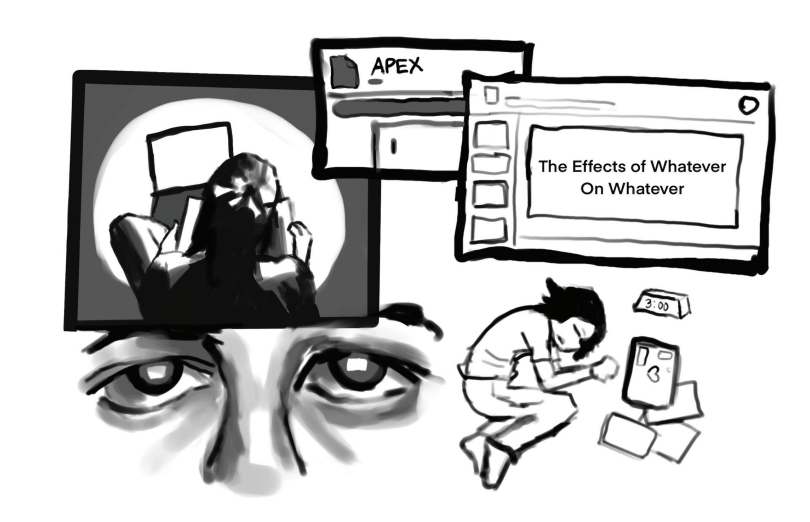
Seniors in this course will generate a 50-page thesis paper on a literary topic of their choosing. Students will be expected to figure out how to scaffold their writing up to 50 pages from what they’ve professed to be limited to in their Chadwick courses: the five-paragraph TEA essay. Such important course questions include: will my organizational strategy be TEAEAEAEAEAEAEAEAEAEAEAEAEAEAEA, TEA TEA TEA TEA TEA TEA, TEATEATTEEEEEAAAAAATATATATAEEEE, or another format? Why can’t a theme be a single-word noun, like “love” or “loss”? Do I need quotes in a literary analysis paper? Students who enroll in this course will be exempt from doing their Apex project but instead will use the Apex presentation day to defend their thesis in front of a committee of science and math teachers, bored middle school students, and random parents.
We are thrilled to offer such an array of courses. Any and all questions can be directed to your advisor, your outside college counselor, or your aunt, who was an English major at Princeton in the 1980s. They will offer advice far more convincing than that of your current or future English teacher.