





























Fifty-seven years after Neil Armstrong and his American crew made history, the National Administration of Space and Aeronautics (NASA) is back at it.
Artemis II, the second in a series of moon missions, plans to send a crew of four astronauts first around the Earth, then around the far side of the moon. The full mission will take ten days from launch to completion.
The second in the Artemis series comes four years after Artemis I, an uncrewed mission around the moon designed to test various technologies in preparation for a living crew.
However, Artemis II has been delayed twice, once due to weather conditions on Jan. 30 and again on Feb. 20, due to a discovered helium leak requiring repairs.
The project serves a twofold purpose: to test the Space Launch System (SLS) rocket, and to ensure the capabilities of the life-supporting Orion technologies in preparation for a longer deep-space mission—a crewed mission to Mars.
This mission sends a four-person crew, not to land but to endure a long-distance mission and the arduous condition of space.
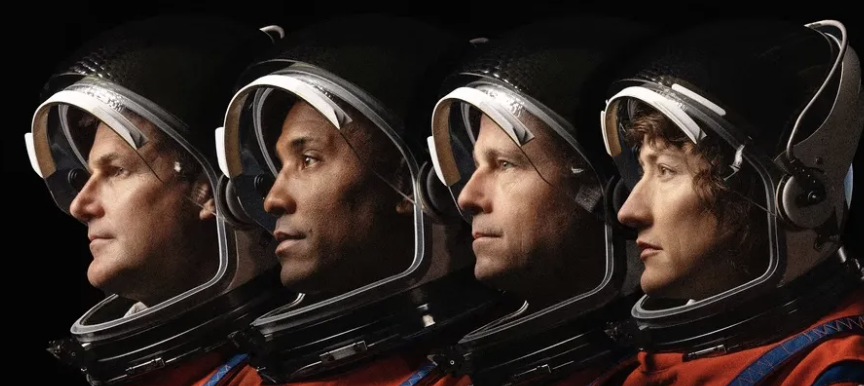
After spending years in training, Commander Reid Wiseman, Pilot Victor Glover, and Mission Specialists Christina Koch (NASA) and Jeremy Hansen (Canadian Space Agency) committed to the Artemis II mission. Each was specifically selected for prior experience or mechanical aptitude, with Wiseman having spent 165 days aboard the International Space Station.
When this article went to press, the launch of Artemis II had been rescheduled for April 1 and no earlier, over two months later than its original date. The shuttle and rocket will release from the Kennedy Space Center, making their exit from the atmosphere visible to many excited Floridians.
Any announcement from NASA is a dopamine surge for many space enthusiasts, but at the same time, many find themselves asking a question: why go back to the moon? One can’t help but wonder if the Artemis series is just an extension of the earlier Apollo missions: a means of demonstrating power in the face of other space programs quickly advancing internationally, like those of China and India. NASA argues otherwise: Artemis II brings an African American, a woman, and a Canadian to space, hoping to shift the tendency of white, American men in space-related media. It’s an international collaboration, not a promotion of American might.
Another of Artemis’s FAQs concerns why it took so long to launch another moon mission. To answer that: It goes without saying that space travel is difficult. Some people suggest that the technology that brought us lunar-bound in 1969 didn’t belong to the United States to begin with. (Look into Roswell, New Mexico if you’re up for a good conspiracy theory.) Especially now, as we attempt a lunar mission again with real computer technology, NASA is essentially rebuilding its space-travelling vehicles from the ground up with a fully different plan, focusing on life support and comfort for our brave explorers.
That said, as our technology develops, NASA’s missions become more ambitious and more extraordinary. Artemis II is the latest prong of that trend, but many more exciting missions are close around the corner.